
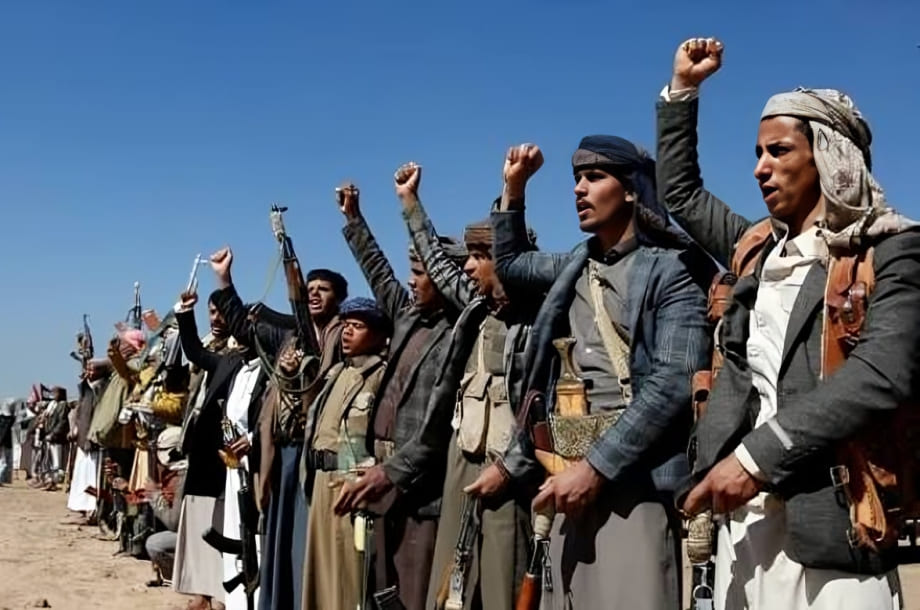
The Houthis’ latest escalation points to a growing connection between the domestic pressures facing the Iran-backed Houthi movement (Ansar Allah) and its widening military activity beyond areas under its control. Attacks on Saudi Arabia and commercial shipping, followed by an expansion of operations in Marib, Hadramout and Mokha, have coincided with signs of economic deterioration and tribal tensions in northern Yemen. This raises a question that goes beyond the idea of simply diverting pressure outward: Is the group using escalation to rebuild deterrence and strengthen its economic and political position at a moment of heightened domestic vulnerability?
The question has gained greater urgency following a warning by UN Special Envoy for Yemen Hans Grundberg on Thursday, August 13, that the country risks sliding back into its broadest conflict since the 2022 truce. Yemen’s current trajectory is being shaped by the interaction of economic, tribal and military pressures with a regional conflict that is expanding the scope for escalation while simultaneously narrowing the space for a negotiated settlement.
Escalation and Vulnerability
An analysis published by the US-based The Cipher Brief argues that the Houthis’ domestic and external challenges have become increasingly intertwined. It points to mounting economic pressure and tribal challenges, particularly in Al-Jawf, where the Dahm tribe has mobilized extensively against Houthi authorities.
The analysis offers three practical explanations for the timing of the escalation. The first is deterrence: the group may be seeking to prevent its adversaries from interpreting domestic difficulties as a sign of diminished willingness to confront them.
The second is economic. Pressure on Saudi Arabia could provide leverage to secure resources or concessions that would help ease the group’s financial difficulties.
The third relates to the tactical opportunity created by disruptions in the Strait of Hormuz, which have increased the importance of Bab al-Mandab and the Red Sea to Saudi energy routes.
This framework helps explain some patterns in recent Houthi behavior. The group has focused its attacks on targets with significant economic and political value while appearing to calibrate the escalation to remain below the threshold of an all-out confrontation. Yet such an approach offers only short-term responses to deeper challenges involving the economy, tribal relations, and the group’s ability to finance both its governing apparatus and its war effort.
Developments in Al-Jawf are particularly significant in this context. Throughout the war, Yemen’s tribes have remained important political and social actors whose relationships with competing authorities cannot be reduced to fixed loyalties. As resources decline, maintaining networks of alliances becomes increasingly costly. If tribal tensions intensify alongside economic pressure, domestic vulnerabilities could shift from manageable challenges into constraints that directly affect the Houthis’ ability to sustain external escalation.
Escalation Inside Yemen
These domestic pressures coincide with an expansion of military operations against areas held by the Yemeni government and forces aligned with it. The Foundation for Defense of Democracies has warned that attacks in Marib, Hadramout and Mokha signal a risk of renewed large-scale confrontation after years in which Yemen’s main front lines remained relatively stable.
These operations serve two purposes. They increase pressure on the Houthis’ Yemeni adversaries while allowing the group, in its political messaging, to frame local battles as part of its confrontation with Saudi Arabia. Houthi-affiliated media have described some of the attacks as targeting “Saudi military buildups,” although most of the targets were Yemeni forces.
Saudi Arabia, meanwhile, has so far shown no clear appetite for a return to a large-scale ground war. Riyadh is balancing deterrence and the protection of maritime traffic with an effort to keep the door to negotiations open. This makes the current phase particularly sensitive. The absence of a major response could encourage the Houthis to test further limits, while a broader military response risks reopening a war that the parties have sought to contain since 2022.
These concerns also featured in Grundberg’s briefing to the UN Security Council, in which he linked continued attacks on shipping to the risk of drawing Yemen deeper into the regional conflict. He stressed that the relative calm enabled by the 2022 truce cannot be sustained without political progress and called for de-escalation and a ceasefire.
Strategic Significance
The current trajectory suggests that the Houthis’ domestic difficulties are closely connected to their external behavior. Escalation provides the group with tools of deterrence, leverage to strengthen its negotiating position and, potentially, opportunities to secure economic gains. At the same time, it increases the group’s dependence on a continuing environment of conflict.
This presents a difficult challenge for Yemen’s peace process. As escalation becomes a means of managing domestic economic and political pressures, turning periods of relative calm into a sustainable settlement becomes more difficult. The widening regional conflict also gives local actors additional reasons to postpone concessions and ties Yemen’s trajectory more closely to understandings reached beyond its borders.
Reviving the political process will therefore require more than a temporary reduction in attacks. Mediation efforts will need to address the pressures that make escalation a rewarding strategy, particularly access to resources, salary payments, the security of critical facilities, and the relationship between the economy and the financing of war.
The Key Indicator
The direction of the next phase will depend on whether the Houthis can contain economic and tribal pressures without turning external escalation into a permanent source of resources and political legitimacy. If domestic tensions deepen while attacks on Saudi Arabia, government-held fronts and commercial shipping continue, escalation could increasingly become a mechanism for maintaining the cohesion of the group’s governing system rather than a temporary instrument of negotiation.
A political track that addresses resources, salary payments and the security of critical facilities while bringing attacks to a halt would point in a different direction: toward moving from the management of interconnected crises to addressing their underlying drivers. This remains the most important condition for preventing Yemen from sliding back into a large-scale war.