
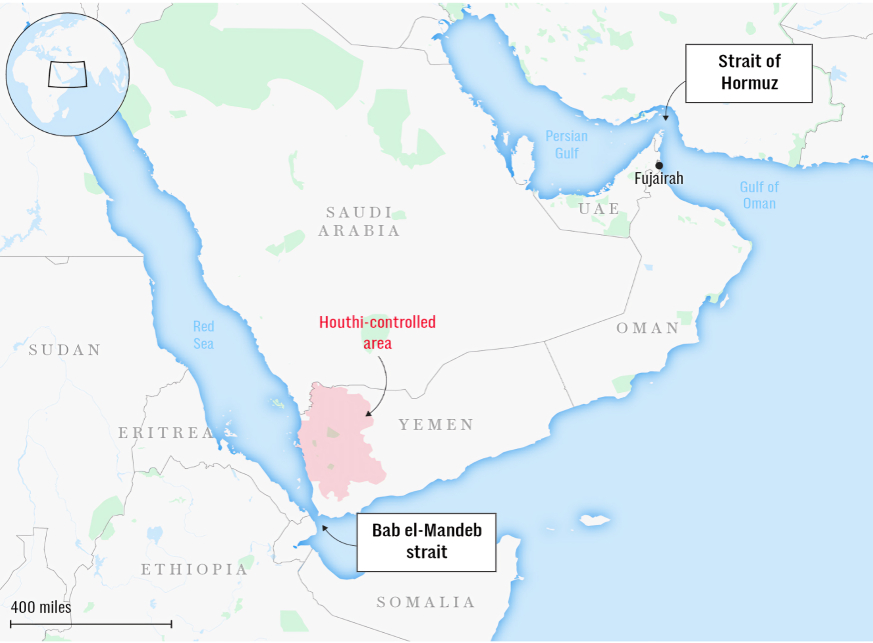
In mid-April 2026, the Yemeni crisis entered a phase of “full geopolitical entanglement,” where the national geography is no longer merely an arena for local conflict, but has transformed into a “strategic lever” in the struggle over international waterways. The Awsan Center for Media and Peace Analysis observes a dangerous shift in the nature of regional pressures, where the balances of the Strait of Hormuz are intertwined with the security of the Bab al-Mandab Strait as a single, indivisible bloc.
While reports by the US *Wall Street Journal* on April 14 indicated intense Iranian pressure on the Ansar Allah movement in Yemen to close the Bab al-Mandab Strait or impose “transit fees,” stern UN warnings have emerged regarding the consequences of such a slippery slope.
The Awsan Center believes that the Yemeni parties’ gambling on regional variables—as described by UN Envoy Hans Grundberg before the Security Council—represents “betting on a storm that no one can control.”
The danger of this phase lies in the transformation of “de-escalation” from a national entitlement serving Yemenis into an international “bargaining chip.” This threatens to erode national ownership of political decision-making and exposes Yemen to “structural shocks” that the current fragile situation cannot withstand.
The Maritime Trade-off: Bab al-Mandab in the Balance of Hormuz
The strategic reading by the Awsan Center points to the emergence of an unprecedented “mutual deterrence” equation among regional and international powers. Leaks from officials to the *Wall Street Journal* revealed strenuous Saudi efforts to pressure Washington into lifting the blockade on the Strait of Hormuz to avert an Iranian reaction in the Red Sea.
The Awsan Center observes that Riyadh securing commitments from the Ansar Allah movement not to target Saudi ships represents “brinkmanship diplomacy,” yet it does not protect international navigation from the “militarization of corridors” scenario feared by Israel and Western powers.
According to the *Wall Street Journal* regarding the threat to impose sovereign fees at Bab al-Mandab under pressure from Tehran, navigation has morphed from a commercial service into an excessive political “pressure tool.” The continuation of this trend, coinciding with the speech by the movement’s leader, Abdul-Malik al-Houthi, on April 16—which linked the fate of the truce to the “Axis fronts” and the situation in Lebanon—practically means that the Yemeni peace track has become a “temporal hostage” to understandings between Washington and Tehran. This strips the national “Roadmap” of its independent substance, reducing it to an echo of cross-border conflicts.
Speech
https://www.saba.ye/ar/news3686518.htm?cid=76
Internal Fragility and Polarization Pressures at the Security Council
On the field and political levels, the Awsan Center notes an increasing “security vulnerability” parallel to the division of international positions within the Security Council. While the Chinese delegate warned against the “stalling of dialogue tracks,” Russia warned against the consequences of isolating any Yemeni party. Meanwhile, Paris and the UN stressed the necessity of dialogue among forces on the ground, specifically in southern Yemen, to avoid undermining the national framework.
The Awsan Center believes that the recent unrest in Mukalla, Hadhramaut, and the casualties during protests reflect an “erosion of trust” in the ability of local institutions to contain livelihood crises amid a preoccupation with major conflicts.
According to statements by Amr al-Bidh to the British *Telegraph* on April 15, weakening the ground forces that constrain the coastal operations of the movement bolsters threats to navigation. This overlap between “local protests” and “international polarization” makes the resumption of a comprehensive political process extremely difficult. The divergence of political agendas and the faltering of trust-building prevent the achievement of “solid consensuses,” keeping Yemen as an open arena for settling regional scores at the expense of national aspirations for stability.
Statements
https://www.telegraph.co.uk/world-news/2026/04/14/saudi-arabia-pressures-trump-to-scale-back-war-on-iran/
The Awsan Center’s analytical reading concludes that continuing to “hold de-escalation hostage” to the dynamics of the straits conflict threatens to evaporate the humanitarian gains of the past two years. The only way out to prevent Yemen from turning into a “buffer zone for conflicts” lies in creating a “sovereignly shielded” negotiating track. This track must separate the livelihood needs of Yemenis from the military equations of the regional axes, ensuring that Yemeni peace does not become merely collateral damage in a confrontation that Yemenis have no say in starting or ending.